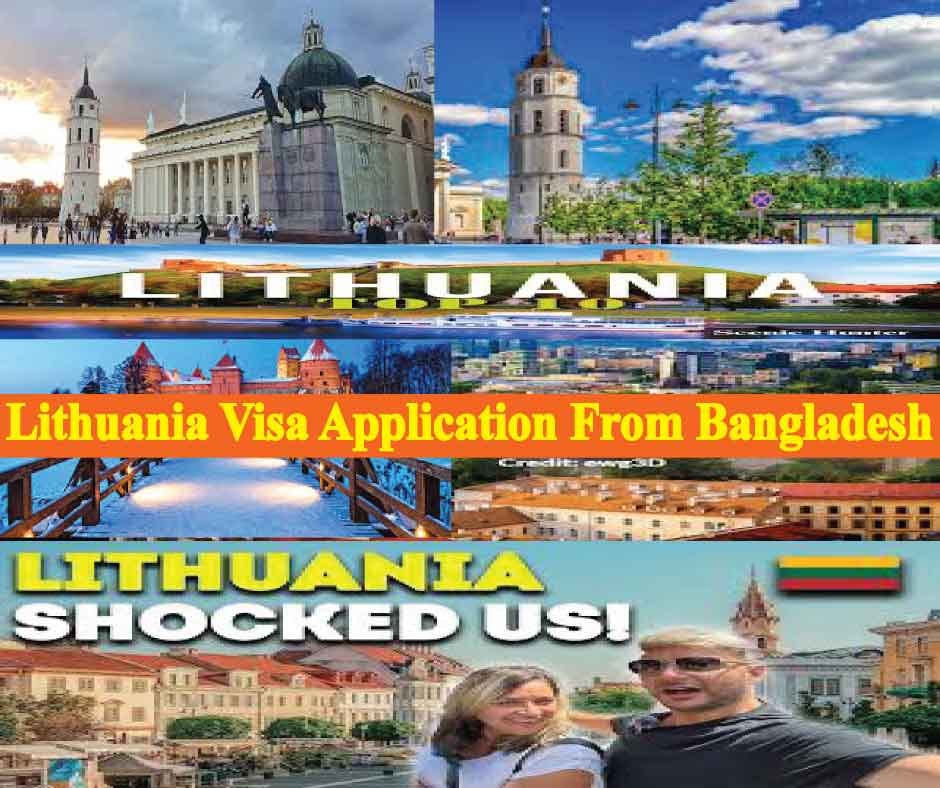

Many professionals and skilled workers in Bangladesh dream of working in Europe/Africa, but visa barriers often block the path. Even when a European job is secured, the complex visa application, labor market tests, and bureaucratic hurdles discourage many applicants. For 2025, Lithuania job opportunity 2025 programs (particularly in technology, logistics, agribusiness, hospitality, and seasonal sectors) are emerging as a viable gateway. By aligning your aspirations with Lithuania’s evolving immigration policies, you can transform the visa challenge into a real work path within the the Europe Schengen sphere.
In effect, the Lithuania visa application from Bangladesh is not just about travel — it can be a stepping stone to a Europe Schengen work visa (or national long-stay visas allowing work) that opens doors across Schengen countries. This article explains definitions, advantages, step-by-step processes, expert insights, actionable tips, and FAQ from real use cases.
Understanding Key Terms & Context. What is “Lithuania visa application (Bangladesh)”?
A Lithuania visa application (Bangladesh) refers to the process whereby a Bangladeshi national applies for a Lithuanian visa (short-term or long-term national visa) from Bangladesh (or from neighboring consular jurisdictions). Because Bangladesh does not host a full Lithuanian embassy with visa operations (only an honorary consul in Dhaka) in.mfa.lt, many applications for national (long-stay/work) visas for Lithuania are processed via external visa centers (e.g. via VFS or designated Lithuanian embassies in India or other consular posts). The official electronic portal for visa filings is EPM (Electronic Visa Application System) for Lithuania. visa.vrm.lt
Short-stay (Schengen) visas are also relevant when entering Lithuania (as it is part of Schengen) for stays up to 90 days.
What is the “Europe Schengen work visa” concept?
While there is no single pan-Schengen “work visa,” the phrase Europe Schengen work visa is often used to denote the set of national visas/permits that allow employment within a Schengen (or EU) country, including pathways to work in any Schengen zone. For non-EU nationals, this typically means:
-
Getting a national long-stay visa (type D) or residence permit based on employment in a specific Schengen country (e.g. Lithuania).
-
After a period, you may get mobility rights or change employer (depending on local law and EU rules).
-
In certain cases, a special permit like the EU Blue Card may function across EU/Schengen states.
Lithuania, as an EU / Schengen member, participates in this system. A person who obtains legal employment authorization in Lithuania via national visa may also enjoy some doors to broader European mobility (depending on EU rules). Remote+2Migration and Home Affairs+2
Thus, applying for a Lithuania work visa is in many ways your entry ticket into the Europe Schengen work visa domain.
Why Consider Lithuania Job Opportunity 2025 as Your Solution?Lithuania’s evolving immigration landscape for 2025
Lithuania made significant immigration changes entering 2025 to control work permits, quotas, and labor market alignment. Newland Chase+2micenter.lt+2 Key shifts:
-
A quota system for non-EU nationals in many job sectors (24,830 quotas in 2025) micenter.lt
-
If a role exceeds salary thresholds (≥ 1.2 × average gross salary) or falls under high value / shortage professions, the quota constraint may be bypassed micenter.lt+1
-
Work permit processing is more standardized; some decisions can happen within days or weeks under streamlined rules Remote+3Playroll+3Globalization Partners+3
Benefits of targeting Lithuania in 2025
-
Strategic EU location & lower cost: Lithuania often has lower living and regulatory costs compared to Western Europe, making adjustment easier.
-
Growing labor demand: Some industries (tech, agritech, manufacturing) are actively recruiting foreign workers.
-
Schengen + EU pathways: Once you hold a national visa and residence permit of an EU country, you may gain further European mobility or eligibility for long-term EU residency (depending on your visa class).
-
Transparent permit rules: Lithuania provides clarity on salary limits, permit types, and quotas. micenter.lt+2Migration and Home Affairs+2
-
Family inclusion potential: Some visa/residence permit schemes allow bringing dependents. DAAD Scholarships 2026+2Remote+2
Thus, aligning your Bangladesh-to-Lithuania visa application with Lithuania job opportunity 2025 is not only feasible — it’s strategically smart.
Lithuania Visa Application (Bangladesh) for Work
Below is an end-to-end blueprint:
Secure a valid job offer from a Lithuanian employer
-
You must receive a formal employment contract / job offer specifying position, salary, work location, employer details.
-
The employer must be registered, authorized, and willing to apply for your work permit or labor authorization.
-
In many cases, the employer or recruitment agency will handle parts of administering the mediation invitation / labor market test / permit application process. Pebl+4Migration and Home Affairs+4in.mfa.lt+4
Employer files for work permit / labor authorization
-
For many roles, the employer must apply to the Lithuanian Employment Service (Užimtumo tarnyba) or relevant authority for a work permit or labor market decision.
-
Applicants whose roles are above the salary threshold or in high-value shortage professions may bypass some quota restrictions. Migration and Home Affairs+4micenter.lt+4Express Global Employment+4
-
Processing is often swift (some reports say as little as 7 working days). Express Global Employment+3Globalization Partners+3Playroll+3
Choose visa route: national long-stay (D) visa or temporary residence permit
-
After labor authorization, the applicant may apply for a national visa (Type D), which allows entry and stay beyond 90 days. Playroll+4VFS Global+4Remote+4
-
Alternatively, in some cases a temporary residence permit application is filed directly (or after arrival). Remote+2Playroll+2
-
Some transitional “visa-during-permit-decision” status may exist to allow you to stay while processing. Remote+2Migration and Home Affairs+2
Fill out and submit the visa application (EPM / visa center)
-
Use the Lithuania EPM (Electronic Visa Application System) website to fill in the visa form. visa.vrm.lt
-
After submission, print, sign, and affix your photo, then submit to the consular post / visa center. visa.vrm.lt+1
-
Bangladeshi applicants typically route applications through external consular jurisdictions (e.g. via Indian Lithuanian embassy / VFS) because of limited local infrastructure. Playroll+4Sticker Visa+4in.mfa.lt+4
-
Upload or present supporting documents (see next step).
Prepare and submit supporting documents
Below is the typical set of required documents (always check with the relevant consular post):
| Document | Purpose / Notes |
|---|---|
| Valid passport | Must be valid at least 3 months beyond visa validity, with ≥2 blank pages Migration and Home Affairs+3VFS Global+3Worldwide Recruitment Solutions+3 |
| Passport photos | As per visa specs (e.g. 35×45 mm) VFS Global+2Worldwide Recruitment Solutions+2 |
| Job offer / employment contract | Core proof of employment relation Playroll+3ACAD+3Worldwide Recruitment Solutions+3 |
| Mediation / invitation letter / work permit decision | The employer’s clearing via labor agency or permit office micenter.lt+5VFS Global+5Migration and Home Affairs+5 |
| Proof of qualifications & experience | Degrees, certificates, CV, reference letters Playroll+3ACAD+3Worldwide Recruitment Solutions+3 |
| Health insurance | Must cover entire stay; minimum sum often ~ €30,000 VFS Global+2VFS Global+2 |
| Proof of accommodation | Lease, host letter, hotel booking etc. ACAD+2Worldwide Recruitment Solutions+2 |
| Proof of financial means | Bank statements, salary slips, etc. VFS Global+2Worldwide Recruitment Solutions+2 |
| Police clearance / no criminal record | Sometimes required (recent) Worldwide Recruitment Solutions |
| Translation / legalization | Non-English/non-Lithuanian docs may require translation and/or legalization/apostille VFS Global+2Worldwide Recruitment Solutions+2 |
Attend visa center / consular appointment & biometric capture
-
You may be called for biometric data (fingerprints + photo) during the appointment.
-
Submit original documents, pay visa fees (e.g. ~ EUR 60 for national visa) VFS Global+2VFS Global+2
-
Some consulates may require an interview.
Wait for decision & collect visa
-
National visa decisions typically take ~ 15 working days (but could vary) Migration and Home Affairs+3VFS Global+3Globalization Partners+3
-
If approved, you can legally enter Lithuania, then convert to a residence permit if required.
-
If denied, consular office should provide reasons for refusal.
Upon arrival: register, apply for residence permit, start work
-
Within Lithuania, you may need to go to Migration Department to convert visa into a temporary residence permit tied to employment. Remote+2Playroll+2
-
Register your address, health insurance, social security, and start your employment contract legally.
-
If necessary, apply for permit extension or renewal before expiry.
Benefits & Expert Insights. Key benefits of the Lithuania-based Schengen work pathway
-
Legitimacy & stability: Working under an official permit protects your rights (salary, insurance, legal recourse).
-
European exposure: Living in an EU country opens doors to networking, intra-EU job mobility, and future EU residency options.
-
Lower competition: Compared to high-demand countries like Germany or France, Lithuania offers niches where competition is lower.
-
Quota flexibility: High-paying roles may bypass quotas — good incentive to negotiate salary.
-
Potential family reunification: Some permit types offer options to bring family later.
Expert tips from migration / immigration advisors
-
Salary threshold matters — Ask your employer to offer at least 1.2× average gross salary if your profession is not on shortage lists; this may waive quota barriers. micenter.lt+2Express Global Employment+2
-
Use precise job titles — That match Lithuanian classification systems; vague titles lead to rejection.
-
Prepare translations & legalization upfront — Avoid last-minute rejections.
-
Apply early — Permit + visa processes may overlap; give buffer time.
-
Track quota status — Especially in peak months; if quotas for your sector fill up, you may need to reapply next cycle.
-
Leverage high-value professions — If your job is in ICT, engineering, health, R&D, many “shortage profession” perks may apply.
-
Ensure employer compliance — Confirm they will legally file permit and cover official costs; shady employers may exploit.
-
Maintain clean legal record — Any past legal issues or criminal record make rejection more likely.
Real-World Use Cases & Practical Examples. Rajib — IT developer from Dhaka
Rajib, a software developer in Dhaka, received a remote job offer from a Vilnius-based tech firm. They offered €3,000/month, well above the average Lithuanian gross salary threshold. His employer applied for a work permit, filed the mediation letter, and Rajib applied for a national D visa via the EPM portal. He got approval within ~2 weeks, arrived, converted to residence, and now works in Lithuania’s tech sector, paying local tax and social contributions.
Salma — Seasonal agriculture worker
Salma got hired to work in Lithuania’s seasonal berry harvest (up to 6 months). Her employer applied for a seasonal work permit and then she applied for a national visa for the duration. She arrived, worked, and after the season returned to Bangladesh. She can reapply for the next season. Migration and Home Affairs+2Playroll+2
Arif — Engineer aiming for EU mobility
Arif, with a master’s in electrical engineering and 3 years’ experience, negotiated a salary above 1.2× Lithuania’s average. His job fell under a high-value field. He got a faster permit, then later used his residence to apply for a more stable EU Blue Card scheme (if eligible) and explore opportunities in neighboring Schengen states (within EU mobility rules).
Actionable Tips & SEO/Authority Boosters
-
Optimize your CV for Lithuanian employers, include relevant keywords (e.g. “Lithuania job opportunity 2025,” “EU projects experience,” “Schengen work eligibility”).
-
Link internally to relevant pages (for example: “see our guide to Schengen visa types,” or “Lithuania labor market analysis 2025”) to keep readers engaged.
-
Use semantic variations: “Lithuania work permit,” “Lithuania national D visa,” “Schengen employment permit,” “Lithuania visa from Bangladesh,” “EU work visa for Bangladeshis.”
-
Include testimonies or case studies (as above) to enhance trust.
-
Encourage next-step actions: “Check open laky Lithuania job portals,” “Contact Lithuanian labor migration offices,” “Prepare your documents early.”
Frequently Asked Questions (FAQs)
- Q1: Can a Bangladeshi apply for a Lithuania Schengen (short-stay) visa AND then convert to work permit?
A: A short-stay (C) Schengen visa is for stays up to 90 days and does not permit employment. You must follow the national visa (D) or residence permit route for work, so converting from C to D is usually not allowed. - Q2: What is the visa processing time for Lithuania national (D) visa?
A: Typically ~ 15 working days, though faster or slower depending on consular backlog. VFS Global+2Remote+2 - Q3: What is the cost of application / work permit / visa?
A: National visa (D) fee ~ €60 (consular) VFS Global+1. Work permit fees vary: up to ~ €121 for 1 year, seasonal up to ~ €34, renewal ~ €52. micenter.lt - Q4: Can I bring my family (spouse / children) with me?
A: In many long-stay permit schemes (not seasonal), yes — dependent on the permit class. Playroll+3DAAD Scholarships 2026+3Remote+3 - Q5: What happens if quota in my job sector is full?
A: You may need to negotiate higher salary (≥ 1.2× average) or apply in a shortage profession classification, which may override quota constraints. micenter.lt+2Express Global Employment+2 - Q6: Where do I submit my visa application from Bangladesh?
A: Likely through a VFS/Visa Application Center or via a Lithuanian embassy outside Bangladesh (e.g. India). Bangladesh only has an honorary consul in Dhaka, not a full embassy. visa.vrm.lt+3in.mfa.lt+3in.mfa.lt+3 - Q7: Can I switch employer after arriving?
A: Typically any change requires new permit or internal permit amendment; you must comply with rules set by Lithuanian Migration Department.
Application Link & Source Links
-
Lithuania EPM / Electronic Visa Application System (for filling visa application) — https://visa.vrm.lt/epm/pages/applications/applicationEdit.xhtml visa.vrm.lt
-
VFS Global – Lithuania visa application (general portal) — https://visa.vfsglobal.com/arm/en/ltu/apply-visa VFS Global
You may also check these sources for further detail:
-
Lithuanian work permit rules & employer obligations: Micenter.lt – Work Permit micenter.lt
-
EU Immigration Portal – employed worker Lithuania conditions Migration and Home Affairs
-
Lithuania work visas & employer guide (Playroll) Playroll
-
Lithuania seasonal worker visa rules (Home Affairs) Migration and Home Affairs